Many businesses still treat their website as a digital brochure.
They create a homepage, add a short about section, list services, upload a few images, include a contact form and assume the website is complete. It may look professional. It may communicate basic information. It may even impress people visually.
But a brochure-style website rarely supports serious growth.
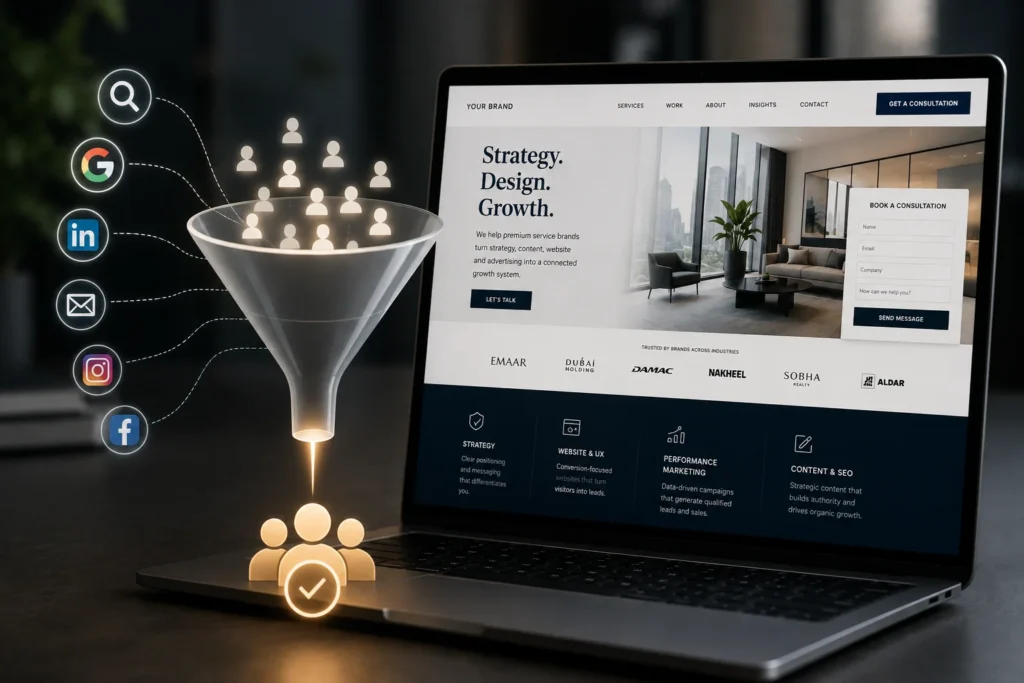
A modern website should not only show who the business is. It should guide users, build trust, answer questions, support search visibility, qualify leads and move potential customers toward action.
Your website is not a passive presentation tool.
It is a growth system.
A Website Is Often the First Serious Trust Test
Before contacting a company, many customers visit the website.
They want to know whether the business feels real, credible, professional and relevant. They look for signals of trust, even if they do not consciously describe them that way.
Is the website clear?
Is the company easy to understand?
Does the design feel current?
Are the services explained properly?
Is there proof of experience?
Are contact details easy to find?
Does the brand feel legitimate?
Does the content answer real questions?
If the website feels vague, outdated or incomplete, users may leave before any conversation starts.
This is especially true for high-value services. When the decision involves money, risk, reputation, health, property, investment or long-term commitment, people need more reassurance.
A weak website does not only reduce traffic performance. It reduces trust.
Design Is Important, But Design Alone Is Not Enough
A beautiful website can still fail.
It may have elegant visuals, premium colors and smooth animations, but if the message is unclear, users will not convert. If the structure is confusing, they will not find what they need. If the pages are thin, search engines may not understand the site. If there is no proof, the brand may not feel credible.
Design should support the business goal, not replace it.
A growth-focused website combines visual quality with strategic clarity. It should look professional, but it should also explain value. It should feel modern, but it should also guide decisions. It should express the brand, but it should also remove friction.
The question is not only, “Does the website look good?”
The better question is, “Does the website help the user understand, trust and take action?”
That is the difference between visual design and growth design.
The Homepage Should Create Immediate Clarity
The homepage is not just a welcome page. It is a positioning page.
Within a few seconds, users should understand what the business does, who it serves and why it matters. If they need to scroll endlessly or interpret vague statements, the homepage is not doing its job.
Many homepages use broad statements like:
“We help businesses grow.”
“We deliver innovative solutions.”
“We are your trusted partner.”
“We create premium experiences.”
These statements sound polished, but they do not say enough.
A stronger homepage explains the specific value of the business. It makes the category clear. It identifies the audience. It communicates the outcome. It gives users a reason to continue.
The homepage should not try to say everything.
It should create enough clarity and confidence for users to explore the next step.
Service Pages Should Sell Understanding, Not Just Services
Many service pages are too thin.
They list what the company offers, but they do not explain the problem, the process or the value. They describe deliverables but not outcomes. They tell users what the business does, but not why it matters.
A strong service page should answer key questions:
What problem does this service solve?
Who is it for?
When does a business need it?
What is included?
How does the process work?
What result should the client expect?
What makes the approach different?
What should the user do next?
This matters for both conversion and SEO.
Search engines need enough content to understand the page. Users need enough clarity to trust the service. Sales teams need a page that supports conversations instead of forcing them to explain everything from the beginning.
A good service page does not only describe.
It educates and persuades.
Content Turns a Website into a Decision-Support System
A website without strategic content is limited.
It can introduce the brand, but it cannot answer all the questions users have before they decide. That is why blog articles, guides, FAQs, case studies and educational pages matter.
Content helps users move through the decision journey.
At the beginning, users may not fully understand their problem. Educational content helps them define it.
In the middle, they compare options. Comparison content helps them evaluate.
Near the end, they need proof. Case studies, testimonials, process pages and detailed service explanations reduce uncertainty.
This is how content supports growth.
It attracts organic traffic.
It builds authority.
It helps users make decisions.
It gives sales teams useful resources.
It improves internal linking.
It strengthens topical relevance.
A blog should not be a random publishing section. It should be connected to the commercial structure of the website.
Every article should have a strategic role.
Credibility Must Be Designed Into the Website
Credibility is not created by one element. It is built through many small signals.
A credible website shows that there is a real organization behind the brand. It provides clear contact paths. It presents accurate information. It uses professional design. It avoids errors. It explains its services clearly. It includes proof where relevant. It makes the user feel that the business is active, responsible and trustworthy.
Some credibility signals are obvious: testimonials, case studies, client logos, certifications, team profiles, office information and portfolio examples.
Others are more subtle: page speed, mobile usability, grammar quality, consistent visual identity, updated content, clear navigation and transparent process descriptions.
When these signals are missing, users may hesitate.
A website does not need to over-explain everything. But it should remove avoidable doubt.
In digital environments, trust is designed.
Navigation Should Reflect the User Journey
A website’s navigation is not just a menu. It is a map of how the business thinks.
If the navigation is confusing, the user experience becomes frustrating. If important services are hidden, users may not discover them. If the structure is too broad, the brand may feel unclear.
A strong website structure should help users find what matters quickly.
The main navigation should usually include the key commercial areas: services, industries, work or case studies, insights, about and contact. For more complex businesses, it may also include solutions, resources or specific customer segments.
Internal linking is equally important.
A blog article should connect to a relevant service page. A service page should connect to proof. A case study should connect to related services. A contact page should be easy to reach from every meaningful path.
Good navigation supports both users and search systems.
It makes the website easier to understand.
Conversion Is Not Just a Button
Many businesses think conversion means adding more buttons.
But conversion is not only about CTAs. It is about the entire experience that makes someone ready to act.
A user converts when enough trust, relevance and clarity have been created.
This means conversion depends on the headline, the page structure, the copy, the proof, the offer, the form, the visual hierarchy, the speed, the mobile experience and the perceived risk of taking the next step.
A strong website should have clear conversion paths for different levels of intent.
Some users are ready to request a consultation.
Some want to read more.
Some want to see work examples.
Some want to understand the process.
Some want to compare options.
Not every user should be pushed into the same action immediately.
A growth system gives users the right next step based on where they are in the journey.
SEO Should Be Built Into the Website, Not Added Later
SEO is often treated as something to fix after the website is built.
This is inefficient.
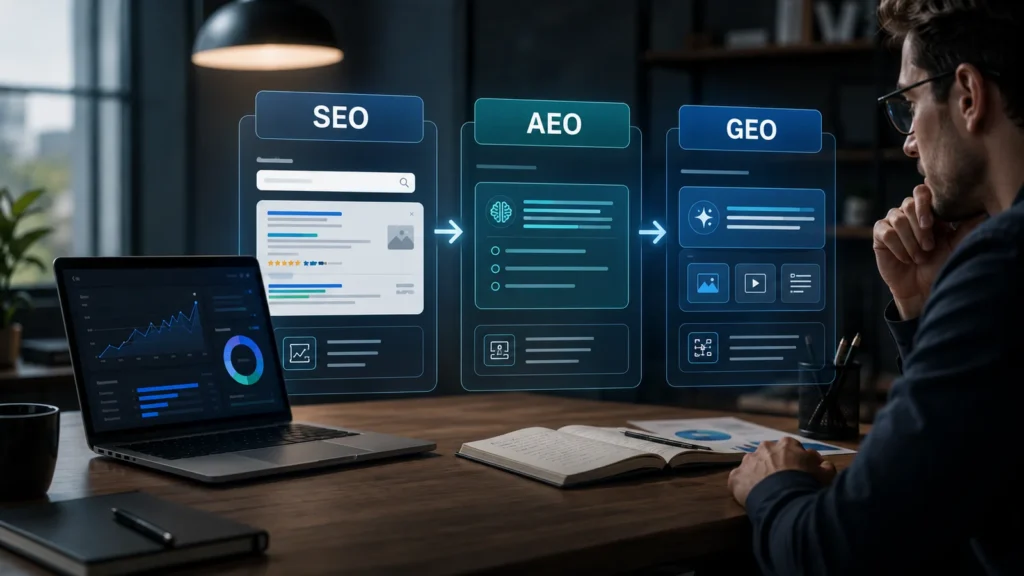
A website should be designed with search visibility in mind from the beginning. Page hierarchy, URL structure, heading logic, service page depth, internal links, content clusters, metadata and technical performance all influence how well the site can perform organically.
If SEO is ignored during design and development, the business may later need to rebuild major parts of the site.
A growth-focused website connects design, content and search.
It makes the business understandable to users and search systems at the same time.
A website that looks good but cannot be found is incomplete.
A website that ranks but does not convert is also incomplete.
The strongest websites do both.
The Website Should Support Sales
A good website does not replace sales. It strengthens sales.
When users contact a business after reading clear service pages, case studies and educational content, the conversation starts at a higher level. They already understand the brand. They have fewer basic questions. They may be more qualified. They may also trust the company more before the first call.
This improves sales efficiency.
A weak website forces the sales team to start from zero. A strong website prepares the prospect.
It explains the business.
It frames the problem.
It shows proof.
It answers objections.
It creates confidence.
For high-value businesses, this is critical. The website is part of the sales infrastructure, not separate from it.
Conclusion: A Website Should Work as a Business Asset
A brochure website presents information.
A growth website creates movement.
It helps users understand the brand, trust its expertise, explore its services, learn from its content, evaluate proof and take the next step.
The difference is strategic intention.
A website should not be judged only by how it looks. It should be judged by what it helps the business achieve.
Does it clarify positioning?
Does it build credibility?
Does it support search?
Does it guide users?
Does it improve lead quality?
Does it help sales?
Does it create trust before contact?
If the answer is no, the website may be attractive but commercially weak.
Your website is not just where people find your business.
It is where they decide whether your business is worth trusting.