Search is no longer only about ranking on a results page.
For years, businesses approached search with a relatively simple goal: appear on Google, rank for relevant keywords, attract organic traffic and turn that traffic into leads or sales. That logic still matters, but the environment around it has changed. Search is becoming more conversational, more contextual and more answer-driven.
People are no longer typing only short phrases into search engines. They are asking complex questions. They are comparing options. They are looking for direct explanations. They expect fast answers, but they also want trustworthy sources behind those answers.
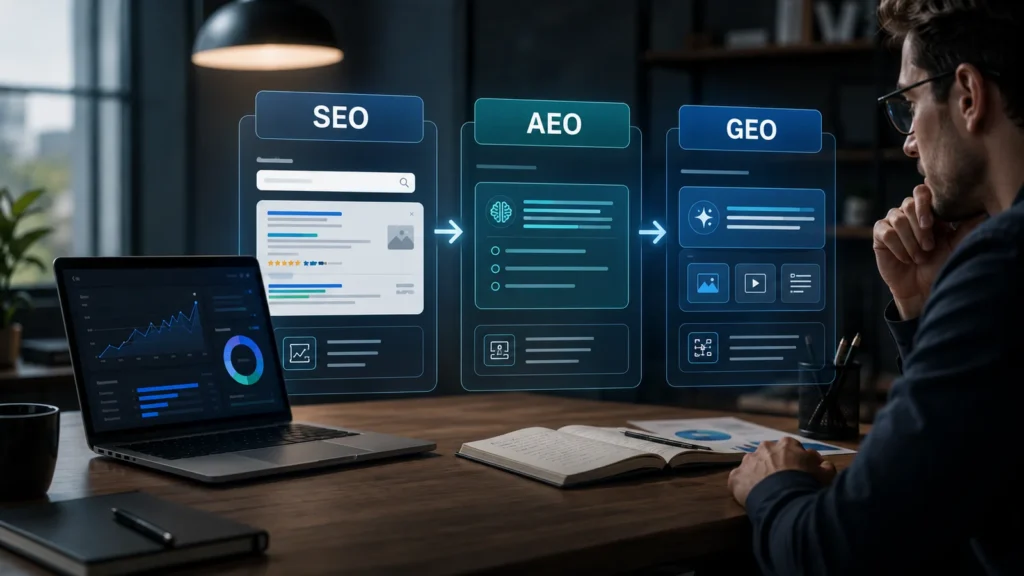
This shift has introduced new terms into the marketing conversation: SEO, AEO and GEO.
SEO stands for Search Engine Optimization.
AEO stands for Answer Engine Optimization.
GEO stands for Generative Engine Optimization.
Each term reflects a real change in how people discover information. But businesses should be careful not to treat them as separate magic formulas. The foundation remains the same: a brand must create useful, credible, accessible and well-structured content that helps people make better decisions.
The difference is that in 2026, search visibility is no longer only about being found.
It is about being understood, trusted and selected as a useful answer.
Search Has Shifted from Keywords to Questions
Traditional SEO was built around keywords. Businesses researched what people searched for, created pages around those terms and tried to rank above competitors.
That approach is still useful. But keyword matching alone is no longer enough.
Modern users search with more specific intent. Instead of searching only for “marketing agency,” they may ask:
“How do I know if my business needs SEO or paid ads first?”
“Why am I getting leads but not converting them?”
“What should a professional service website include?”
“How can a brand appear in AI search results?”
“What is the difference between SEO, AEO and GEO?”
These are not just search queries. They are decision-making questions.
This is important because businesses often create content for visibility, but not for decision support. They write pages to attract traffic, but the content does not help users understand the problem, compare options or move closer to action.
In an answer-driven search environment, that is a weakness.
If a business wants to perform well in search, it must stop thinking only about keywords and start thinking about the questions behind the keywords.
Good content answers the question the user actually has.
Better content answers the question behind that question.
Strategic content helps the user make a smarter decision.
SEO Still Matters, But Its Role Has Expanded
SEO is not disappearing. It is becoming more strategic.
Businesses sometimes assume that AI search will replace traditional search optimization. In reality, the core principles are still essential. Search engines and AI-powered search experiences need access to content. They need to understand what a page is about. They need signals of quality, relevance and trust.
That means the fundamentals still matter:
A website must be technically accessible.
Important pages must be crawlable and indexable.
Content must be helpful and original.
Pages must be structured clearly.
The user experience must be reliable.
The brand must demonstrate credibility.
The website must be easy to navigate.
What has changed is the standard of content quality.
A thin service page with generic language may have worked years ago. Today, it is less likely to stand out. A blog post written only to repeat a keyword may bring little value. A website that looks polished but does not explain its services clearly may fail both users and search systems.
SEO in 2026 is not only about optimization. It is about clarity.
A strong SEO strategy should connect technical performance, content strategy, brand positioning, website architecture and conversion logic. The goal is not just to bring more visitors. The goal is to attract the right visitors and help them understand why the brand matters.
AEO: The Rise of Answer-Driven Visibility
Answer Engine Optimization is often described as the practice of optimizing content so it can be used in direct answers.
This idea became more important as search engines, voice assistants and AI-powered platforms started giving users summarized responses instead of only showing lists of links.
But AEO should not be treated as a shortcut. It does not mean adding a few FAQs to a page and expecting results. It means building content that is clear enough, useful enough and structured enough to answer real questions.
For businesses, this creates a major opportunity.
Most brands still talk mainly about themselves. They explain their services, their experience and their process. But users are often looking for answers to their own problems.
A user may not care immediately that a company offers “end-to-end digital marketing solutions.” They want to know why their ads are not converting, why their website has traffic but no inquiries, why their content is not building trust or why competitors appear more visible in search.
AEO pushes brands to become more useful.
Instead of only creating pages like:
“Our Services”
“About Us”
“Why Choose Us”
Businesses should also create content that answers:
“What should you fix before increasing ad spend?”
“How do you know if your website is hurting conversions?”
“What makes a brand trustworthy online?”
“How should businesses prepare for AI search?”
“What is the role of content in a growth system?”
These questions are closer to the user’s actual decision journey.
AEO is not only a search tactic. It is a customer understanding discipline.
GEO: Visibility in Generative Search
Generative Engine Optimization focuses on how brands appear within AI-generated responses.
As AI tools become part of the discovery journey, users may not always click through multiple websites in the traditional way. They may ask an AI system for explanations, recommendations, comparisons or summaries. In that environment, brands want their content to be recognized as useful, credible and relevant.
But GEO should not be understood as a completely separate discipline from SEO.
Businesses should not chase tricks. They should not rely on artificial methods or assume that one technical file, one schema type or one formatting pattern will guarantee visibility. The stronger approach is to build content that is genuinely useful and easy to interpret.
Generative systems work best when information is clear, structured and supported by context.
That means businesses should create pages that define concepts, explain processes, compare options, answer common concerns and show expertise in a way that can be understood beyond a single keyword.
For example, a weak page says:
“We provide professional branding services for ambitious businesses.”
A stronger page explains:
What branding includes.
How branding differs from positioning.
Why visual identity alone may not improve conversion.
How brand strategy affects website copy, advertising, content and sales.
What signs show that a brand needs repositioning.
How a business should evaluate the impact of branding work.
The second version is more useful for users. It is also more useful for search systems and AI-generated responses because it contains clearer meaning.
GEO rewards depth, structure and relevance.
The Real Competition Is Clarity
Many businesses believe their biggest search competitors are the companies ranking above them. That is only partly true.
The deeper competitor is unclear communication.
A brand can lose visibility because its website does not explain what it does clearly. It can lose leads because its service pages sound like every competitor. It can lose trust because its content is too vague. It can lose authority because it publishes articles without a strategic point of view.
Generic content has become a serious problem.
Phrases like “tailored solutions,” “trusted experts,” “innovative approach,” “premium service” and “customer-centric strategy” may sound professional, but they rarely create differentiation. If any competitor can say the same thing, the message has limited value.
Search visibility increasingly depends on specificity.
A brand should be able to explain:
Who it serves.
What problem it solves.
What makes its approach different.
What process it follows.
What outcomes it supports.
What clients should understand before making a decision.
What mistakes the audience should avoid.
This type of clarity does more than improve content quality. It improves the entire customer journey.
When a user understands a brand faster, trust develops faster. When trust develops faster, conversion becomes easier.
Website Structure Matters More Than Ever
A website is not just a design asset. It is a knowledge system.
If the structure of a website is weak, search visibility becomes harder. Users may not find the information they need. Search engines may struggle to understand the relationship between services, industries, articles and commercial pages. AI-powered systems may not identify the brand as a strong source of answers.
A strong website structure should make the business easy to understand.
The homepage should explain the brand’s value quickly.
Service pages should explain problems, process and outcomes.
Industry pages should show relevance to specific audiences.
Blog articles should answer real questions.
Case studies should provide proof.
Internal links should connect educational content to commercial pages.
Contact paths should be clear and low-friction.
Many businesses treat blog content as separate from the rest of the website. This is a mistake.
A blog should not be a disconnected archive of articles. It should support the commercial structure of the site. If a business offers SEO, the blog should answer SEO-related questions and link naturally to the SEO service page. If it offers website development, the blog should explain website strategy, UX, conversion and technical foundations. If it offers branding, the blog should educate users on positioning, differentiation and brand trust.
This creates topical authority.
It also helps users move from learning to inquiry.
Content Should Support the Full Decision Journey
Not every user is ready to buy immediately.
Some users are just becoming aware of a problem. Some are comparing solutions. Some are evaluating providers. Some are almost ready to contact a company, but still need reassurance.
A strong search strategy creates content for each stage.
At the awareness stage, users need education. They may search for problems, symptoms or general explanations.
At the consideration stage, users need comparison. They may search for differences between services, options, tools or strategies.
At the decision stage, users need proof. They want case studies, process clarity, pricing logic, credentials, testimonials and direct next steps.
Many businesses only create content for the awareness stage. They publish general articles but fail to create pages that help users choose.
That creates traffic without conversion.
A better approach is to map content to the journey:
Educational articles attract attention.
Comparison articles help users evaluate options.
Service pages explain commercial relevance.
Case studies build confidence.
Landing pages convert campaign traffic.
FAQs remove friction.
Strong contact pages make action easy.
SEO, AEO and GEO work best when they are connected to this full journey. Visibility without conversion is incomplete. Conversion without trust is fragile. Trust without clarity is difficult to build.
Industry Implications: What This Means in Practice
The shift toward answer-driven search affects different sectors in different ways.
For professional services, the opportunity is to explain expertise before the first conversation. Consultants, legal firms, financial advisors, agencies and B2B providers should create content that shows how they think, not only what they sell. Buyers in these sectors want confidence. They need to understand the process, risks, decision criteria and expected outcomes.
For real estate and property-related businesses, the opportunity is to move beyond listings and promotional messages. Users want guidance, comparisons, area insights, investment logic, buyer mistakes and process explanations. Search content should reduce uncertainty and position the brand as an advisor.
For luxury and hospitality brands, the challenge is to express value that is often emotional and experiential. Beautiful visuals matter, but search requires language. These brands should explain standards, personalization, access, privacy, service philosophy and the details that make the experience distinctive.
For healthcare, wellness and clinics, clarity and trust are critical. Content should answer patient concerns responsibly, explain suitability, outline consultation steps and avoid exaggerated claims. Search visibility in this space must be built on credibility and care.
For technology and SaaS businesses, content should clarify use cases, integrations, workflows, implementation and measurable business impact. The more complex the product, the more important structured explanation becomes.
Across all sectors, the principle is the same: brands must turn expertise into accessible knowledge.
What Businesses Should Stop Doing
To adapt to search in 2026, businesses must stop treating content as a volume game.
Publishing more articles is not always better. Publishing better articles is.
Businesses should stop creating generic blogs that do not answer real questions. They should stop writing service pages that only list deliverables. They should stop copying competitor language. They should stop separating SEO from brand strategy. They should stop assuming that design alone will make a website perform.
They should also stop chasing every new acronym without understanding the fundamentals.
AEO and GEO are useful concepts, but they do not replace quality. A business cannot compensate for unclear positioning with technical tricks. It cannot build authority with shallow content. It cannot convert users if the website does not explain value.
The brands that adapt well will be the ones that combine strategy and execution.
They will build websites that are technically strong and commercially clear. They will publish content that educates and converts. They will write for users while making information easy for search systems to understand. They will connect visibility with trust.
A Practical Framework for 2026 Search Readiness
Businesses can prepare for the new search environment by reviewing five areas.
The first area is technical accessibility. Important pages should be crawlable, indexable and easy to navigate. A search system cannot use what it cannot access.
The second area is content usefulness. Each page should answer a real user need. If a page exists only because a keyword exists, it may not be strong enough.
The third area is structure. Headings, internal links, page hierarchy, FAQs and content sections should make the information easy to scan and understand.
The fourth area is credibility. Businesses should show proof: case studies, experience, process, testimonials, certifications, team information, client results or other trust signals where appropriate.
The fifth area is conversion alignment. Organic visibility should lead somewhere meaningful. Users should know what to do next, whether that is reading a related article, viewing a service page, downloading a resource or contacting the business.
This framework helps transform SEO from a traffic activity into a growth system.
The Future of Search Belongs to Useful Brands
The future of search will not reward brands simply because they publish more. It will reward brands that help users understand better.
This is a major shift.
In the past, a business could often compete by targeting the right keywords and producing enough content. Today, search success requires stronger thinking. Brands need sharper positioning, clearer writing, better website structure and a deeper understanding of the customer journey.
SEO, AEO and GEO are not separate islands. They are connected parts of one larger reality: people are using search to find answers, not just websites.
A business that wants to be visible must become a better answer.
That means explaining problems clearly.
It means showing expertise without overcomplicating the message.
It means creating content that supports real decisions.
It means building a website that helps both users and search systems understand the brand.
It means treating visibility as part of a larger trust-building system.
In 2026, the strongest brands will not be the ones that only optimize for algorithms.
They will be the ones that earn attention through clarity, usefulness and credibility.
Because search is changing.
People are no longer only searching for businesses.
They are searching for answers.
And the brands that become the best answers will become the brands people remember, trust and choose.